In shortMilford Sound wildlife means New Zealand fur seals basking on the ledges at Seal Rock and bottlenose dolphins, both reported year-round, plus Fiordland crested penguins at their landing beaches from July to December and humpback whales rarely in October and November. Below the hull, DOC's marine reserve runs 16 km along the fiord and protects black coral. No sighting is guaranteed.
16 kmmarine reserve along the fiord
690 hectaresprotected since 1993
7 millionblack coral colonies in Fiordland
July to Decembertawaki at landing beaches
Milford Sound wildlife by season
New Zealand fur seals haul out on the sun-warmed ledges at Seal Rock, and bottlenose dolphins live in the fiord. Both are reported in every month of the year, as are kea at the road stops. Everything else on the list comes down to chance.
Penguins are the one real seasonal story. Watch and listen for Fiordland crested penguins, tawaki, at their landing beaches across the July to December stretch. Chicks leave the colony at about 75 days old, which falls in late November or early December. Successful breeders come back in late January or early February to moult for roughly three weeks, then most head to sea by late February or early March and stay there until late June or early July. That makes autumn the thinnest stretch of the year for them. Humpback whales turn up only rarely, in October and November, as they move north in spring.
Sources differ a little on exactly when the penguin window closes, so treat late spring as possible rather than promised. Ask the crew on the day what has been seen around the fiord that week.
| Species | How likely | When | Where in the fiord |
|---|
| New Zealand fur seals | The most reliable sighting | Year-round | Seal Rock ledges |
|---|
| Bottlenose dolphins | Resident; appears on some sailings | Year-round | Open water along the fiord |
|---|
| Dusky dolphins | Occasional visitors | No set season in the facts | Near the fiord entrance |
|---|
| Fiordland crested penguins (tawaki) | Seasonal and shy | July to December at landing beaches | Shoreline beaches and rocks |
|---|
| Humpback whales | Rare | October and November | Spring migration past the entrance |
|---|
| Kea | Common in the car parks along the road | Year-round | Milford Road, including Monkey Creek |
|---|
Milford Sound seals and dolphins you can count on
Seal Rock is the landmark where fur seals most often bask, and it is the one stop where the skipper usually slows and holds position. The animals lie on flat, sun-warmed rock close to the waterline, so take an outside deck rather than a seat behind glass in the saloon.
Bottlenose dolphins are the resident dolphins here and are reported in every month. No pod figure is published for the fiord, so plan for a chance encounter rather than a scheduled one: they appear mid-fiord, sometimes alongside a moving hull, and a sighting can last two minutes or twenty. Dusky dolphins turn up occasionally, and when they do it is usually nearer the entrance, the stretch of water only the longer sailings reach.
DOC asks visitors not to approach marine mammals or penguins, and to let the animal start any close contact. On a boat that means staying where you are and keeping quiet when something comes in, rather than twenty people shifting to one rail at once.
Boutique sailing, quiet deck
A small-boat cruise of 1 hour 45 minutes, from NZ$189 and rated 4.9 (3,254 reviews), gives you space at the rail when the boat slows beside the seal ledges.
★ 4.9/5 · 3,254 reviews
Penguins and the birds along the Milford Road
Tawaki are harder work than the seals. They come and go from landing beaches at the forest edge and are often heard before they are seen. The species is classed as 'Declining'; surveys in the 1990s found 2,260 nests, a figure described as a minimum. Binoculars make the difference between a dark shape on wet rock and a positive identification.
The road in is its own wildlife stretch. Kea work the car parks, Monkey Creek most of all, and they are the bird most people photograph on the way home. Feeding them is prohibited and it harms them; if one has landed on your vehicle, wait for it to leave rather than driving off. For something quieter than a car park, stop at the forest walks: the flat Lake Gunn loop from the Cascade Creek car park, about 78 km from Te Anau and roughly 45 minutes, and the easy, wheelchair-accessible Mirror Lakes boardwalk about 56 km north of Te Anau, best early while the water is still.
Two rules catch people out here. Drones are prohibited at Piopiotahi Milford Sound and across Fiordland National Park, so a long lens is the only reach you get. Dogs have no access to any part of the park either, the Milford Road corridor included, so a roadside wildlife stop is not somewhere to bring one.
What the marine reserve protects below the boat
Every day boat crosses the Piopiotahi (Milford Sound) Marine Reserve, established in 1993 and managed by DOC, which runs 16 km along the fiord and covers 690 hectares. What it exists for is mostly invisible from the deck: the black coral trees the fiords are known for.
The reason those corals sit within reach of a diver's torch is the water itself. More than 7 metres of rain in an average year pours fresh, tannin-stained water over the top of the salt water, and that dark layer cuts the light so sharply that most marine life in the fiords stays in the top 40 metres. Deep-water species move up into it. Fiordland's black coral grows in water as shallow as 10 metres, while the same corals elsewhere in the world live at roughly 200 to 1,000 metres down. Fiordland holds one of the largest populations anywhere, around 7 million colonies, some of them up to 200 years old.
Seeing the coral without diving means the underwater observatory in Milford Sound. Its status has changed in recent years, so confirm it is operating before you pay extra for any package that leans on it.
Where to stand, and what to bring
Time of day matters as much as position. Milford Sound Tourism Limited, which runs the harbour, wharves, terminal and car parks, tells drivers to be on the road before 8am or after 11am; for a wildlife watcher that doubles as a note about which boats fill up, because the sailings in between take the coach arrivals. An early or late boat means fewer people at the rail when something surfaces.
- Take an outside deck position early and keep it. The seal ledges and most dolphin encounters happen low and close to the hull, where the saloon windows do not help.
- Binoculars for the penguins and the shoreline, a longer lens for anything on the rock. The walls here reach 1,692 m at Mitre Peak, so scale tricks you into thinking animals are closer than they are.
- Wear a hooded waterproof jacket and leave the umbrella at the hotel. Rain gear is needed in any season in a place averaging over 7 metres a year, and the wettest sailings often have the most activity around the boat.
- Keep the noise down near the ledges and let the animals set the distance, as DOC asks.
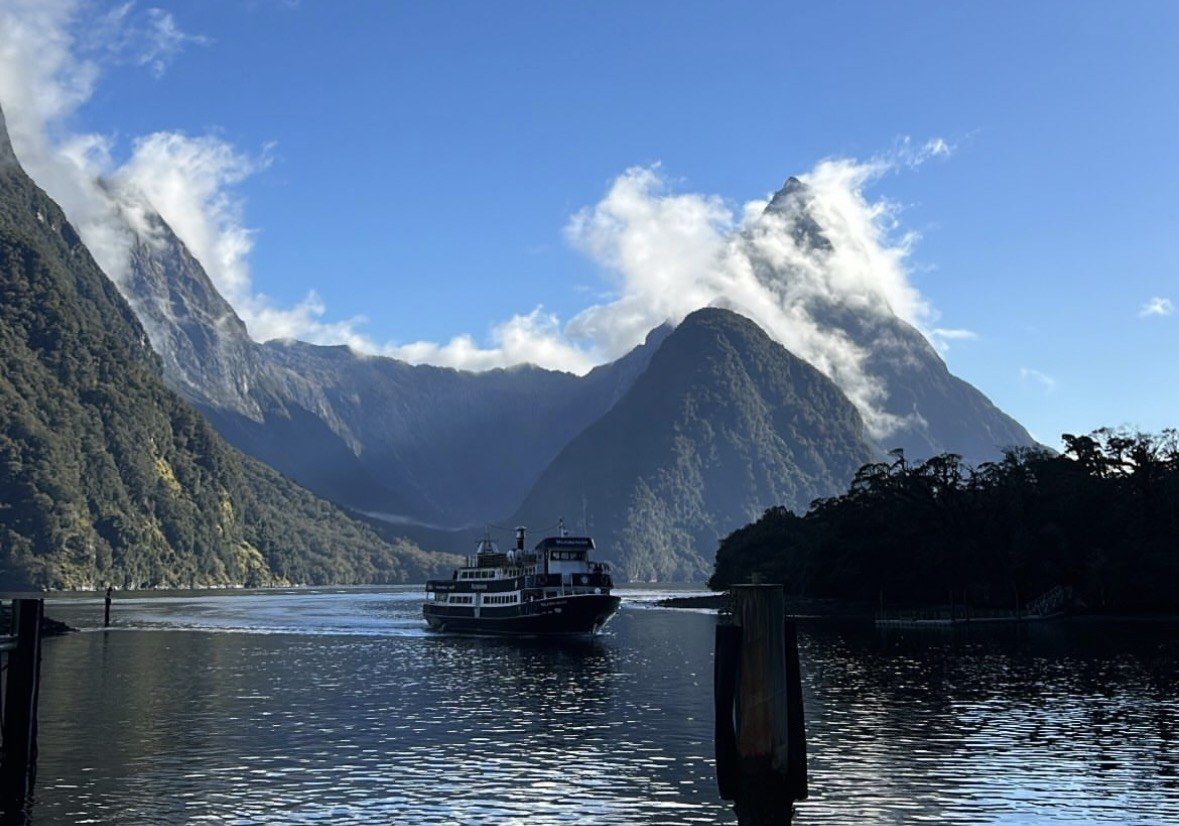
- Vessel size decides your view: the large day-cruise boats carry up to 180 and up to 120 guests, while the smaller licensed boats are capped at no more than 75 aboard.
- Eat before you check in if you are on the boutique sailing: coffee, tea and biscuits are included and no food is sold on board.
Choosing a sailing for the best wildlife chances
Pick the longest time afloat on the smallest boat you are willing to pay for. Every day cruise works the same 16 km of protected water, so extra minutes buy slower passes near the rocks where the seals lie and more time towards the entrance, where dusky dolphins occasionally appear. A smaller vessel also leaves room to stand still at the bow.
For wildlife, the Small Boutique Cruise Experience is the straightforward pick if you are already driving to the terminal: 1 hour 45 minutes afloat, from NZ$189, rated 4.9 (3,254 reviews), with coffee, tea and biscuits the only catering on board. Christmas Day is the only date it does not run, so the winter penguin months are covered, and cancelling up to 24 hours ahead costs nothing. Parking at the main car park is charged separately at NZ$10 per hour, by card at the machines.
Overnight is the move if wildlife is the reason for the trip. The Milford Sound Mariner Overnight Cruise is listed at 2 days, from NZ$1,398, rated 4.7 (167 reviews), with a private en suite cabin, dinner, breakfast and the use of kayaks or tender boats, which puts you at water level in the evening and again early the next morning. These sailings are final sale, so choose a date you are sure of.
No boat can promise an animal. Dolphins do not keep a timetable, tawaki are seasonal and shy, and whales here are a rare October or November event. Book the sailing you would still enjoy with nothing but seals, rock and water, and count anything more as a good day.
Questions people ask
Will I definitely see dolphins in Milford Sound?
No. Bottlenose dolphins are resident and reported year-round, but they are not on every sailing and no operator can schedule them. Fur seals at the ledges are the most reliable sighting of the day, so plan around those and treat dolphins as a bonus.
When is the best month for Milford Sound wildlife?
Spring, for the spread of species. Seals, bottlenose dolphins and kea are reported in every month, Fiordland crested penguins are around their landing beaches from July to December, and humpback whales appear rarely in October and November. Autumn is the quietest stretch, since most tawaki have left for sea by late February or early March.
Can I see black coral without diving?
Black coral in Fiordland grows in water as shallow as 10 metres, which is why divers reach it here when the same species sits at roughly 200 to 1,000 metres elsewhere. Without diving, the underwater observatory in Milford Sound is the way to see it. Check that it is operating before paying for a package built around it.
Why is wildlife so visible near the surface here?
Heavy rainfall leaves a layer of tannin-stained fresh water sitting on the salt water, and it cuts the light so much that most marine life in the fiords stays in the top 40 metres. Species that would normally live deep move up into that darkened band.
Can I use a drone to film the seals?
No. The drone ban covers Piopiotahi Milford Sound and every part of Fiordland National Park. Bring a longer lens instead, and remember that DOC asks visitors not to approach marine mammals or penguins and to let the animals decide how close they come.
Is a longer cruise actually better for wildlife?
Usually, yes. All day boats cover the same protected water, so a longer sailing means more time held near the rock ledges and further towards the entrance, where dusky dolphins occasionally visit. A smaller vessel helps too, because you can keep a clear spot at the rail when something appears.
Read also